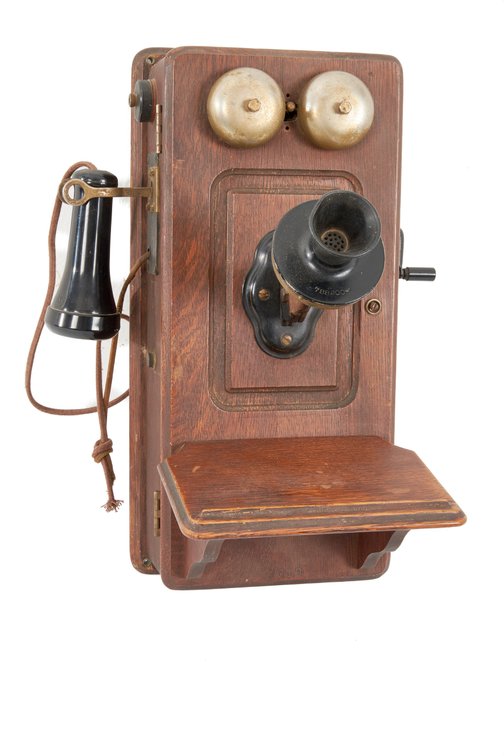
#28 • Antique Kellogg Hand Crank Wall Mount Telephone
Part of Green Gallery - Unique Estate Items, Furniture, Jewelry, Case Knives (timed auction by K and B Auction)
High bid $160.00
Status: SOLD
The phone appears complete, with 4 bar magneto, ringer, and 2 Eveready Columbia Dry Cell 1.5 Volt Batteries. The batteries are in amazing condition with great label graphics. The Kellogg 4-bar dynamo crank phone refers to an early 20th-century wood wall telephone featuring an internal hand-cranked magneto generator with four horseshoe magnets (bars).Manufactured by the Kellogg Switchboard & Supply Company, these iconic "magneto phones" generated their own high-voltage alternating current (AC) to ring the bells on local bridging party lines.Key Specifications & MechanicsThe 4-Bar Magneto: The "4-bar" designation specifically counts the number of physical horseshoe-shaped magnets stacked together inside the phone’s dynamo.Line Compatibility: In antique telephony, a 3-bar generator was typically used for short or series lines. A 4-bar or 5-bar magneto provided the extra voltage needed to push a strong signal through longer rural "bridging" party lines without loading down the circuit.Power Generation: Turning the external side crank rotates an armature within the magnetic field. This produces roughly 70 to 90 volts of AC power—enough to ring the phone's integrated brass bells and alert the operator or other neighbors sharing the line.Local Battery System: While the hand crank powered the ringing mechanism, the actual voice transmission relied on two local 1.5-volt dry cell batteries tucked inside the lower compartment of the wooden cabinet. Great piece of history! Marked 788200L on microphone. The Patent/Design Number: Early telephone manufacturers like Kellogg and Western Electric stamped serials, specific utility patent registration numbers, or production part codes directly onto the faceplate or back of the transmitter casing.The "L" Suffix: In antique telephone manufacturing, the trailing "L" typically denotes a Long-distance or high-resistance transmitter variant. These microphones were packed with denser carbon granules inside the transmitter cup to handle the higher voltage required to push audio signals clearly across long rural party lines. jrb